Ready, Respect, Safe

I had never heard of Charlie Kirk until the news of his murder broke but as soon I was realised he was a close ally of Trump I started to assume that I would find anything he had said objectionable. However, in a much shared quote, Kirk said “When people stop talking, that’s when you get violence. That’s when civil war happens, because you start to think the other side is so evil and they lose their humanity.” That struck a chord with me because I had been thinking along much the same lines over the previous week.

On the previous Saturday, my wife and I had decided to spend our wedding anniversary bearing witness to our belief in the right to life from conception and our grave concerns about assisted suicide by joining the March for Life. After a gentle amble through the streets of Westminster we arrived in Parliament Square where there was also a sea of Palestinian flags (although we didn’t witness any of the 850 arrests that happened there that day). As we listened to the prayers and speeches organised for our event, I noticed some “pro-choice” counter protesters nearby and immediately felt an urge to go over and talk to them. It seemed to me that it would be a missed opportunity to come all this way and not take the time to listen to people with opposing views.

After a while, I plucked up the courage needed to talk to strangers and we went over to them. As soon as they realised that we had come over from the March for Life we were told in no uncertain terms that we had no right to come and talk to them. We tried to explain that we just wanted to talk and listen so that we could better understand each other. However, we were told that “We have nothing to say to you and you have nothing the say to us.” Since we all felt strongly enough about the same issue to turn out in Parliament Square on a sunny Saturday afternoon, it seemed to me that we all had a lot that we could say to each other.  One lady did make an attempt to talk to us and started to explain that she had been raped. However, the others quickly closed ranks and the opportunity was lost behind a wall of “Don’t talk to them:  they’re from over there!” As we took the hint and started to leave, I heard our brief point of contact say “But if we don’t talk to them, how will they ever understand?”  Exactly.

I regret that we didn’t get the opportunity to listen to that lady’s story, had she wished to tell it. I regret that we didn’t get the chance to tell her that however different our views on abortion might be we would never judge or condemn her for the choice she made. I regret that we didn’t get the chance to listen and to talk. It seems to me that if we don’t talk to “them” because they are from “over there” and believe we have nothing to say to each other we are sowing the seeds of division that can spiral into conflicts like the very one in Gaza that inspired the more newsworthy protest on the other side of the square.

So, yes, I do agree with Charlie Kirk that when people stop talking, that’s when you get violence. However, it is a very superficial statement. There is no point talking to people if you don’t also listen to them and there is no point listening to them if you are not open to the possibility that you might learn something from them. Immediately before the quote I started with, Charlie Kirk explained, pressing his fists together as he did so, that he recorded his events and posted them on the Internet so that people could see “these different ideas collide”. He may have seen the need for people to talk to each other but he viewed that act of talking as conflict – a debate to be won or lost – not a conversation to enable learning, growth and understanding. He spoke violence in many other ways too. The quotes are out there; I have no wish to repeat them. I would just add to those words of his that I have chosen to quote a warning that if we speak violence, we seed violence.

In the primary school I work in, we have three basic rules plastered all over the walls: Ready, Respect, Safe. It is amazing how much of what we discuss with the children can be brought back to one of these three words. Over the past week, I have been reflecting on them in the light of Charlie Kirk’s killing and my experiences in Parliament Square. Are we Ready to learn from people with different opinions to our own? Can we Respect people by truly listening to them? And, when we speak, will we choose our words carefully to keep everyone Safe?

What’s the Point of God?

It can feel hard to justify believing in God.  After all, we live in a rational, scientific age where our destinies are controlled by doctors, engineers, economists, computer scientists and, perhaps, politicians.  What, then, is the point of God?  Is God (“the creator and ruler of the universe and source of all moral authority; the supreme being”, to take the first definition Google provided) just an outdated superstition?  Alternatively, in the words of a meme I saw today, is God just an imaginary friend? Why bother with faith, when the world has so many certainties to offer?

On the face of it, the Bible isn’t much help with this problem.  Although written by many people in a wide variety of languages and styles across a vast swathe of time, a common thread is that it was written for peoples who generally believed in something (a god, or several gods):  not for people who felt they had outgrown belief.  Many of the arguments, therefore, are about which god you should worship, the nature of Israel’s God or how God has been revealed to us, rather than for the existence of any kind of deity.  If, with an incredibly broad brush, we see in the Old Testament a record of Israel struggling to maintain faithfulness to God, then when, on frequent occasions, they turn away from God they always turn to something else:  a golden calf, the gods of the Canaanite people or gods of their foreign spouses.  The revelation of Jesus in the New Testament does not come out of the blue to a godless people but is firmly rooted in the Old Testament – a continuation of the revelation to be found there – and comes first to a people steeped in that tradition.  As this fresh understanding of God radiates out beyond the Holy Land in the Acts of the Apostles and through the letters of Paul (and others), we see it increasingly packaged for gentiles, ignorant of the Old Testament message.  Even then (for example, Paul proclaiming the nature of the Unknown God in Athens), it is more a case of “Our God, not your gods” than “God, not no gods”.

It seems to me that the concept of God as “the supreme being” is a stumbling block in the journey towards faith that is very tricky to get around.  It may seem like this stumbling block can only be moved by having someone paint a fully detailed, rational, convincing picture of God.  Who better to do this than a believer?  Well, this believer doesn’t feel he can do that.  Even if we’ve studied all 66 books of the Bible in detail and however close we might feel our relationship with God to be, we know only in part.  As the writer of Job says, “There, these are the fringes of his ways, and what a whisper is the word that we hear of him, so who understands the thunder of his mighty acts?” (Job 26:14) or as Paul wrote, “We see now as through a darkened glass” (1 Corinthians 13:12).  The more I learn, the more I realise I don’t know and (whilst that motivates me to keep learning) the more at ease I feel about not knowing.

Perhaps it is easiest to approach this from a negative perspective:  what do I feel when I hear someone deny the existence of God?  Pity.  I feel pity because I believe they are missing something precious, life-giving and life-fulfilling.  I pity them because what I hear them denying is the existence of truth and love in their purest forms:  absolute truth, total love.  I couldn’t live my life according to a worldview where absolute truth and total love were absent or deniable.  Like God, these are things that we can only perceive in part in this world.  However, we can perceive enough to know that they exist in their purest forms and, knowing that, who would not seek to come closer to them each and every day of their lives?  As Maximillian Kolbe wrote, “No one in the world can change truth. What we can do and should do is to seek truth and to serve it when we have found it.”  Like God, these are things we should seek but not expect to find by our own efforts or on our own terms.  As Simone Weil wrote, “We do not obtain the most precious gifts by going in search of them but by waiting for them.  Man cannot discover them by his own powers, and if he sets out to seek for them he will find in their place counterfeits of which he will be unable to discern the falsity.”  Seek and wait.  In what seems to me to be a classic pattern of Christian thought, we’ve ended up holding two seemingly contradictory ideas together in order to glimpse truth.

At this point I start to feel uncomfortable about my attempts to describe God because I see only in part and because words are such a limited tool for conveying ideas.  It is starting to sound like I am rationalising God away: that I’m saying we can dispense with the word God and dedicate ourselves to serving truth and love.  Although saying that gives a glimpse of what I mean, one that I hope may help some people, I don’t mean to dispense with God.  Having glimpsed absolute truth and total love, why would I not fall down and worship them?  Why would I not fall down and worship God?  Why would I not believe people were created to serve truth and love?  Why would I not believe people were created to serve God?  Why would I not repent bitterly and seek forgiveness when I, inevitably, fail to be absolutely truthful and totally loving?  Why would I not repent bitterly and seek forgiveness when I, inevitably, fail to be like God?

On the other hand, perhaps I am worrying too much.  Perhaps I am not being so heretical.  The Bible tells us, “…love is from God; everyone who loves is born of God and knows God” (1 John 4:7).  Simone Weil wrote, “Christ likes us to prefer truth to him because, before being Christ, he is truth.  If one turns aside from him to go toward the truth, one will not go far before falling into his arms.”  After all, who was it who said, “I am the way, and the truth, and the life” (John 14:6)?  That is the point of God: to show us the way, lead us to truth and give us life in all its fullness.

I started this piece casting doubt on whether the Bible could really speak to people who did not believe in any god and have ended up quoting it in support of God.  The problem wasn’t with the Bible but with the idea, which is commonly held, that there are people who have outgrown faith.  In the end, people always put their faith in something that they never fully understand.  It could be a political party, or a social campaign, or the financial markets, or a social media influencer.  They have fallen into the trap Simone Weil warned of, finding in the place of the precious gifts of truth and love counterfeits of which they are unable to discern the falsity.  Rather than starting, as the Google definition did, with thinking of God as a supreme being, I would start by thinking of a god as something in which people put their faith.  Looked at that way, I would suggest that everyone believes in some god.  Tom Wright illustrates this nicely it in his ‘God and the Pandemic’, “As today’s secularism is more and more revealing its pagan subtexts, it is fascinating to imagine our present dilemma as a clash between Asclepius, the god of healing, and Mammon, the money-god.”  The question then, to which the Bible speaks loudly is: “Which god are you going to believe in?”

Whose Truth Is It Anyway?

My truth?  Your truth?  Her truth?  His truth?  Which one matters?  Which one should we believe?  Which one is true?

It seems to me that the only truth that matters is the truth:  the definite article, you might say.  The truth exists outside all of us.  “The truth may be something that we can never quite reach” (What is Truth?) but it is something we can and should always seek to converge upon.  It is something that can change us for the better, if we allow its beauty and goodness to illuminate the depths of our innermost selves.  It is the one thing that can bring all people together, if we allow out beliefs to converge upon it through the process of enquiry.

Some people might claim that my truth is just another way of saying my opinion or my recollection or my belief.  However, these other options do not explicitly claim superiority over other people.  My opinion may differ from yours but that statement makes no claim that you are wrong.  They contain an implicit humility and openness to other people that is absent from my truth.  If I attempt to take possession of the truth by replacing the definite article with a possessive adjective, then I build a wall between us.  If what you say differs from my truth there is immediately an implication that what you say is untrue:  you are wrong.

Pope Francis wrote, “I like to think that we do not possess the truth so much as the truth possesses us, constantly attracting us by means of beauty and goodness.”  I agree.  However, this doesn’t stop us from attempting to take possession of the truth.  When we do this we are actually attempting to change the truth so that it matches our opinions.  However, we can’t change truth.

Maximillian Kolbe wrote, “No one in the world can change Truth. What we can do and should do is to seek truth and to serve it when we have found it. The real conflict is the inner conflict. Beyond armies of occupation and the hetacombs of extermination camps, there are two irreconcilable enemies in the depth of every soul: good and evil, sin and love. And what use are the victories on the battlefield if we are ourselves are defeated in our innermost personal selves?”

When we attempt to take possession of the truth, when we attempt to change the truth, we reject the truth.  We reject something that could change us for the better.  We reject the one thing that could bring all people together.

Wisdom vs Stupidity

Reading chapter 9 of Proverbs the other day, I was struck by the way in which both Wisdom (v 4) and Stupidity (v 16) try and get the attention of passing people with the same cry of:

“Whoever is naive should turn in here…”

At times of great decision-making such as this, I think we would do well to remember that it is not always easy to tell wisdom apart from stupidity: at least, not at first. It therefore seems to me that we would do well to wish for the gift of discernment to be able to more accurately separate them.

It also seems to me that we would do well to wish for the gift of patience, because true discernment often takes time. If we rush to a conclusion, then we may well miss the opportunity of gaining real understanding. We would, therefore, also do well to be wary of those who tell us to trust them with their easy shortcuts for choosing between wisdom and stupidity.

If wisdom and stupidity are difficult to tell apart, it stands to reason that we will, from time to time, be stupid when we think we are being wise. To guard against this, I think we would do well to always be open to the possibility that we might not be right in our judgements or in our beliefs: even our foundational beliefs.

When asked recently for her favourite quotation, Lady Hale (of prorogation judgement and spider-broach fame) responded with the following from Judge Learned Hand:

“The spirit of liberty is that spirit which is not too sure that it is right.”

She went on to say: “I try not to be too sure that I am right.” (Brief Encounter, Prospect Magazine, December 2019) I think that’s an attitude we’d all do well to emulate.

My prayer at this time is as follows. In true primary-school fashion, feel free to join in with the Amen at the end if you want to make it your prayer too:

Lord Jesus,

At this time of decision,
Grant us the gift of discernment,
That we may better separate wisdom from stupidity.
Grant us the gift of patience,
That we may open ourselves to real understanding.
Grant us the gift of humility,
That we may never be too sure that we are right.

Amen

European Elections: Person or Party?

During the campaign for the last general election, I determined that I should “Vote person, not party” and chose which candidate to vote for on that basis.  In the recent local elections, I applied the same principle (although this was tricky, given the limited information available).  The choice between voting for a person and voting for a party will be starkly presented in black and white on the ballot papers for the upcoming European Parliament elections.  Because these elections use a form of proportional representation, the box that I cross on the form will either be for a political party (with its pre-selected list of candidates) or for an independent candidate (an actual person).  Democratic Audit has published a useful guide to how the elections will work, including a sample ballot paper which nicely illustrates this choice.

Taking a step back for a moment, why am I bothering to think about who to vote for?  Although I voted to leave the EU, whilst we remain a member (however frustrating that may be) it is my view that we should continue to engage constructively with it.  Firstly, I just think that is the right way to behave as a member.  Secondly, we will always have some form of relationship with the EU so it makes no sense to behave in an unnecessarily disruptive manner which will antagonise the institution and its remaining members.  Furthermore, although the MEPs elected may never take up their seats, in these unpredictable times they may end up representing us in the European Parliament for a full term.  For these reasons, whatever your views on Brexit, I think it’s really important for people to consider how to use their vote carefully.

I have to be honest here and admit that for ten minutes or so after the Brexit Party leaflet dropped through the door I did consider voting for them.  Like all party political leaflets it briefly lulled me into a false sense of certain simplicity.  If you want to leave the EU, vote for the Brexit Party and they will make it happen.  However, I quickly remembered this was Nigel Farage’s party.  It’s not that I never think he has a valid point to make; it’s just that I almost always object to the way in which he chooses to make it.  Besides, whatever the media or Nigel Farage or Vince Cable might want us to think, this isn’t a referendum:  it is the election of MEPs who won’t actually determine whether or how Brexit will happen.  That will be decided in Westminster.

Having taken the time to work out how these elections work and given my instinct for person over party, I looked up a list of candidates for the South-West region to see whether I would have the option of voting for any independent candidates (the only people it will be possible to vote directly for).  There are three:  Larch Maxey, Mothiur Rahman & Neville Seed.  After a bit of digging, it transpired that Larch Maxey and Mothiur Rahman are not entirely independent as they are both standing under the Climate & Ecological Emergency Independents banner.  An organised group with a website proclaiming a manifesto sounds suspiciously like a political party to me.  This leaves one truly independent candidate to consider:  Neville Seed.

As an independent candidate with no previous political experience, Neville has certainly set himself a challenge by standing.  Without the financial and logistical resources of a political party behind him, the most immediate source of information available to potential voters is his website.  Reading this, it is apparent that he is at least something of a kindred spirit:  a Leave voter who is disillusioned with party politics but who believes that “if we are to be in the EU then we need to make it work”.  Furthermore, he seems to be in tune with what, to me, are the basics of being an elected representative:  careful scrutiny of proposed legislation, engaging with the electorate and then acting in their interests.  Of course, I don’t agree with everything that he says.  For example, I take a more charitable view of our current politicians.  I believe the majority are well-meaning people who genuinely want to serve but have been stifled by the oppressive party system they feel they have to join in order to attain office.

Neville’s website is there for anyone to read and evaluate.  On Sunday, however, I was able to attend a hustings event in Bristol to see him in action.  Present at this event were (with party affiliation and position on party list in brackets):

  • Ollie Middleton (Change UK, #3)
  • Carla Denyer (Green, #3)
  • Andrew Adonis (Labour, #2)
  • Stephen Williams (Liberal Democrats, #3)
  • James Glancy (Brexit, #2)
  • Neville Seed (Independent)

The event was chaired by Adam Boulton of Sky News.  It was confirmed that the Conservative Party and UKIP had been invited to attend.  There was no mention of the English Democrats or of Larch Maxey and Mothiur Rahman.  Sadly, although somewhat inevitably, proceedings were dominated by Brexit.  This was partly down to the audience repeatedly asking Brexit-related questions, many directed in frustration at James Glancy who thereby benefited from the most talk-time.  However, the candidates themselves set this tone for the afternoon by making their opening pitches mostly about their position on Brexit.  It was amusing to listen to Andrew Adonis making an impassioned plea for remaining in the EU and a second referendum and comparing it to official Labour Party policy!

Neville Seed, however, bucked this trend.  By the time he spoke, I had already jotted down the following potential question “Why do our MEPs’ positions on Brexit matter when the issue will be decided in Westminster or, perhaps, a second referendum?”  I didn’t have to ask this question because Neville made the point for me.  He also made the point that because of the list system and because none of the parties’ first place candidates present, he was the only panelist that your vote could go directly to without first getting someone else elected.  To illustrate this point, let me say that that the speaker who most impressed me was Carla Denyer.  Whilst making a point of her position on Brexit, she also made a concerted effort to talk about other issues.  Until pressed by specific questions, my recollection is that only Carla and Neville took this step.  Carla spoke eloquently when she got the opportunity and dealt clearly and confidently with a question raised about debating with the far-right that arose from the cancellation of a previous hustings event.  If I could vote for her on Thursday I would seriously consider doing so.  However, the closest I could get to doing so would be to vote for the Green Party and, since Carla is third on their list, hope that they get somewhere in the region of 50% of the votes cast in the South-West constituency.  The combination of political parties and this particular form of proportional representation make the whole process rather nonsensical.

The nonsense of political parties further resulted in much time being wasted by two candidates (Andrew Adonis and James Glancy) having to field repeated questions about their party leaders and leadership, rather than about their own opinions.  One breath of fresh air, however, came from Stephen Williams.  One of the final questions asked the candidates to talk about the benefits of Brexit.  Most of the Remain candidates (their terminology, not mine) simply said that there were none.  It is a response I see and hear in many comments on social media:  one that simply shows that the respondent hasn’t taken the time to understand the other side of the argument.  In a complex issue like this, I fail to see how it is possible to form a valid opinion with first understanding the pros and cons of each side of the argument.  Stephen showed one of the few glimpses of liberal thinking by discussing in his response (having first made clear that he personally saw few, if any benefits, in leaving) that there was an argument to be made that our laws should be made in our parliament and that this was an issue that needed to be better addressed by those in favour of EU membership.

As someone sympathetic towards the abolition of all political parties, I cannot bring myself to vote directly for any political party, although I do appreciate that the Green Party at least try to do party politics in a different way.  I would prefer to have a choice between several experienced independent candidates offering a range of personal views.  However, although inexperienced, I have decided that Neville Seed has demonstrated enough to win my vote.  If I didn’t feel confident enough to vote for him to be my elected representative I would have reluctantly spoiled my ballot paper.  He clearly takes a reasonable, pragmatic view of the fact that we are even holding these elections and wants to work constructively with the EU.  He seems to have fundamental beliefs in independent politics similar to my own and has had the courage to do what I have not:  put them to the test at the ballot box.  Vote Neville!

Cycling for the Climate

Avid readers of my Facebook timeline will no doubt recall a seminal post that I made on 28th February of this year:

Cycling home from work just now, I was reflecting on the virtues of my mode of transport. In addition to the health benefits (both physical and, more importantly for me, mental), by breathing in all the particulate emissions being belched out by the vehicles I was sharing the A432 with I was helping to clean the air for everyone else. However, it then occurred to me that I must be breathing out more carbon dioxide than I would be from a sedentary driving position in my car. Now, hopefully the increase in my personal CO2 emission was considerably less than that which my car would have emitted if I’d chosen to drive, but this did get me thinking about the CO2 emitted by people. To what extent does the vast population of people on the planet contribute to climate change simply by means of their respiration? It’s not just the numbers being born but, given the massive increases in life expectancy in recent years, the emissions over a life-time. Are there any data on this? When the Youth Climate Protests were happening a couple of weeks ago, I found myself irreverently wondering whether the best thing our generation could have done to preserve the environment for the next generation would have been to have given birth to fewer of them. Maybe there was something in this thought after all…

Inspired more by the Youth Climate Protests than my own random ramblings, a couple of weeks ago I ordered two books by climate expert Mike Berners-Lee (brother of Tim):  “There’s No Planet B:  A Handbook for the Make or Break Years” and “How Bad Are Bananas:  The Carbon Footprint of Everything”.

img_1052

I haven’t actually read these yet but found myself flicking through the latter earlier on today whilst trying to avoid a household task.  To my surprise and delight, there was a section relevant to my earlier musings.  It turns out that the relative benefits, as far as carbon footprint goes depends on the fuel the cyclist uses:

“If your cycling calories come from cheeseburgers, the emissions per mile are about the same as two people driving an efficient car.”

Carbon emissions are much worse if the cyclist fuels themselves with air-freighted asparagus.  However, given a more sensible diet things look much better:

“Is cycling a carbon-friendly thing to do?  Emphatically yes!  Powered by biscuits, bananas or breakfast cereal, the bike is nearly 10 times more carbon efficient than the most efficient of petrol cars.”

As I found myself doing, the author then drifts onto the carbon inefficiency of living:

“Cycling also keeps you healthy, provided you don’t end up under a bus.  (Strictly speaking, dying could be classed as a carbon-friendly thing to do but needing an operation couldn’t.)”

What more does the carbon-conscious cyclist need to know than that?  Having since flicked through a few more pages, this book certainly appears to be both highly informative and highly amusing for the carbon-conscious, whether they are cyclists or not.

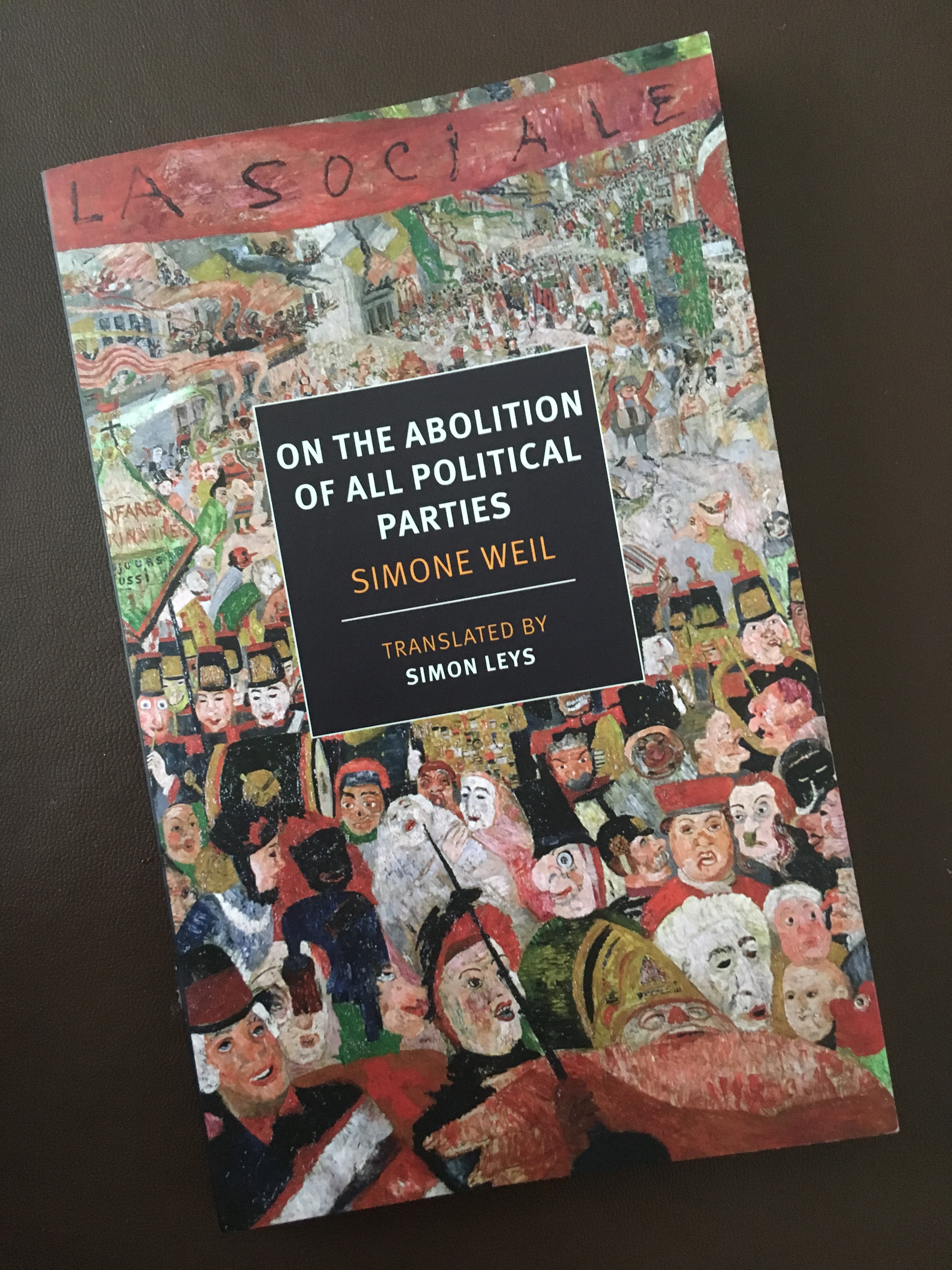
Reflections on “On the Abolition of All Political Parties” by Simone Weil

“The mere fact that they [political parties] exist today is not in itself a sufficient reason for us to preserve them.”

Following the resignations of several MPs from the Labour and Conservative parties back in February, I reviewed some of my writings on political parties.  They started by my questioning the role of truth in our politics with some thoughts on the way politicians try to win our votes by feeding our desire for certainty about the future, when this is something that no one can offer with any degree of honesty (Post-Truth Certainty).  However, it was during the 2017 General Election campaign that I started to seriously question the role of political parties and the manners in which they corrupt our system of representative democracy (A New Kind of Politics?) which then lead me to conclude that the only honest vote was a vote for a person, not for a party (Vote Person, Not Party).  After the election dust had settled, I went on to consider the lies and bribery inherent in that driving force of political parties: the manifesto (Manifestos: The Longest Bribery Notes in History).

Having re-read these articles, it occurred to me that I should redress the balance by studying something of the history of political parties or some form of justification for their existence.  In searching a couple of internet bookstores, however, I stumbled across the slender volume about which I am writing now.  Not being widely read in philosophy, I had never heard of Simone Weil but found the story of her short life very interesting.  Discovering that a French thinker, born 65 years before me, had, in wartime writing that sprung out of reimaging France for a hoped for post-occupation future, reached apparently similar conclusions to the ones I had about the pitfalls of political parties was both fascinating and emboldening.

The opening paragraph of her work immediately shook me out of any complacency with its assertion that her conclusion only applied to Continental political parties in their plebeian origin and not the English political parties of aristocratic origin.  With some thought, however, I realised that when she was writing in 1943 the Labour party had yet to form a majority government of the UK.  I can’t say how much our politics has changed since 1943, or whether any such change has been driven by a party that emerged more from the people than the aristocracy, but I find that all her descriptions of the ills of political parties resonate strongly with the politics I observe in early 21st century Britain.

Weil argues that political parties become ends in themselves, when our only end should be goodness, which can be understood as truth and justice.  How often do we hear the phrase “for the good of the party” (usually measured by votes or financial donations)?  That’s when the party has become the ends.  There is currently a corruption story rumbling on in Canada in which “The former Attorney General says Trudeau and his staff spent months trying to convince her that taking the company to trial would cost Canadians jobs, and their party votes.” (Trudeau and Wilson-Raybould: The scandal that could unseat Canada’s PM, BBC News, 28th February 2019).  The party had become the ends.  Our ends should only ever be truth and justice and we should demand this of our elected representatives too.

There is so much more to draw out from this work about the evils of political parties but, rather than labouring the point further (when anyone who is interested can just read the book for themselves), I want to offer some thoughts on Brexit referenda that came to me whilst I was reading it.  After all, the weaknesses of our political parties have resulted in the European question being left to fester until such time as it is very difficult to resolve it in any practical manner.  They also make it virtually impossible for the parties to resolve the crisis they have allowed to evolve.

Firstly, in taking a step back to lay the groundwork for her argument, Weil summarises Rousseau’s notion of the general will.  In order for the general will to be superior (as measured by truth and justice) to any individual wills the most important condition that must be met is that “at the time when the people become aware of their own intention and express it, there must not exist any form of collective passion”.  To put it another way “When we are calm it is easier to make sensible choices” (Calm).  Just pause and reflect on the 2016 referendum.  Both sides strove to generate fear, whether of immigrants or of financial meltdown.  It was all about winning and losing:  words that generate huge levels of passion (Winning and Losing: A Very Brexit Problem).  It seems fair, therefore, to argue that the referendum cannot have determined the general will.  However, unless a second referendum was to be carried out in a vastly different manner it would similarly fail to determine the general will, regardless of whether or not it reversed the decision of the first.

Secondly, Weil finishes her essay by pointing out that we have learned from politics to approach complex problems in entirely the wrong manner.  We take sides, for or against, and then try to justify our position.  This avoids thinking altogether.  The only path to truth is to meditate upon the problem and then express the ideas that come to our mind.  In order to do this we first need to listen carefully and respectfully to a range of opinions on the problem, in other words to be liberal (Sceptical Liberalism vs Dogmatic Authoritarianism: The Second Dimension of Politics).  Only then will we be ready to ponder patiently in search of the truth (Christmas 2017: Pondering Perplexities).

Returning to the main theme of the book, I note that the newly formed “Independent Group” of MPs is in a rush to become a political party (Independent Group’s plans to register as Change UK party angers petitions site, The Guardian, 29th March 2019).  They know no other way.  In my exploration of the Bible, I am currently reading 1 Samuel in which, after the chaos described in Judges, God accedes to the Israelites’ demands and lets them have a king to rule over them.  It is clear that God regards this as a rejection by his people of Himself as ruler.  Yet Judges is also clear that the moral chaos was because there was no king.  They couldn’t cope having God – having truth and justice – as their sole end.  Although I strongly dislike the phrase, perhaps having a king was ‘a necessary evil’.  Perhaps political parties are such a necessary evil for us.  Even if that is true, this book should be required reading for anyone with even a passing interest in politics in order to remind ourselves of the nature of the evil that is deemed necessary.

I’ll finish these reflections, as I started, with a quote from the text:

“Political parties are a marvellous mechanism which, on the national scale, ensures that not a single mind can attend to the effort of perceiving, in public affairs what is good, what is just, what is true.”

A Letter to The Prime Minister

7th December 2018

Dear Prime Minister,

Thank you for your Letter to the Nation, dated 24th November, which I have read with interest.  I have no doubt that negotiating a Brexit deal has been an onerous task.  Sadly, however, I believe that the deal you have negotiated is not in the interests of the UK.

Over the course of the referendum campaign (at the end of which I voted Leave), I came to realise that there was no compromise that could satisfy a significant majority of the UK as any attempt at compromise would result in the worst of both worlds rather than the best of both worlds.  Retaining frictionless trade or a completely open Irish border must mean remaining bound by a portion, at least, of EU regulations.  Conversely, freeing ourselves completely from the jurisdiction of the EU must mean that trade with the EU will become more difficult (with a consequent short to medium term negative economic impact) and the reality of a border on the island of Ireland.

Furthermore, I realised that the status quo (with our multiple opt-outs) was already an attempt at compromise.  Although – given the pain our relationship with the EU seemed to be causing – this clearly wasn’t working, it was clear to me that any other attempt at compromise would be worse than this status quo because it would mean being subject to EU rules and regulations despite no longer having any influence over them.  Your deal is such an attempt at compromise:  surrendering control rather than taking back control.

In particular the Northern Ireland backstop is a critical issue.  Because the issues around the Irish border will be very difficult to solve, the backstop may well become permanent.  Although no one may be anticipating it being used for long, if at all, the whole history of Northern Ireland is of a solution regarded by many at the time as being temporary (partition) becoming to all intents and purposes permanent.  It seems, therefore, entirely possible that the Irish question could push the EU and the UK into the backstop and then keep them there indefinitely, however much this is against the will of both parties.

I very much share your desire that “we put aside the labels of ‘Leave’ and ‘Remain’ for good and we come together again as one people”.  However, I firmly believe that the best that your deal could achieve is to paper over the cracks for a few years, leaving the fundamental disagreements to fester.  For the country to have come this far and to have suffered so much pain and division on this issue and not resolve it once and for all would be a failure of leadership on a grand scale.  I have never seen any advantage in rerunning the 2016 referendum.  However, I now wonder whether the only way to settle the issue of EU membership is to have a different referendum.  This is because the 2016 referendum asked the wrong question.

In his Bloomberg speech, David Cameron, pledged to give the British people “an in-out referendum”.  Unfortunately, the 2016 referendum did not fulfil this pledge.  Given the opt-outs we currently have, the ‘Remain’ option was not a conclusive vote for ‘In’.  Whilst in voting ‘Leave’ I may have meant, in David Cameron’s words, “come out altogether”, given the wide range of views expressed by different campaigners, the ‘Leave’ option was not a conclusive vote for ‘Out’.

The only way to finally resolve the EU question would be to hold a genuine in-out referendum so that we can choose either to fully commit ourselves to EU membership (Economic and Monetary Union, Schengen and all) or to fully leave the EU in the knowledge that this will make trading with the EU more difficult (but by no means impossible) and will mean a border between Northern Ireland and the Republic of Ireland (the hardness of which can only be negotiated with the EU once it is clear that leaving means coming out altogether).  Although both options have costs and benefits, they are the only two options that are sustainable in the long term because they would fully commit us to a clearly defined path.

It has been reported (Brexit deal: Theresa May gives herself two weeks to win over MPs, The Guardian, 26th November 2018) that you have called on MPs to “consider the interests of their constituents” when deciding how to vote on the deal.  I am therefore copying this letter to my MP.  Since I am responding to a public letter, I am also copying this letter to my blog.

Yours sincerely,

[My illegible signature.]

cc:       Mr Luke Hall, MP for Thornbury & Yate

Abortion: A Liberal Blind-Spot

“I’m determined to do this as quickly as possible but I’m also determined to get it right for women and get it right for doctors…”  With these words (Abortion legislation will take until the end of the year, Harris reveals, Irish Independent, 29th May 2018), Irish Health Minister Simon Harris began the process of drafting new abortion legislation following the Irish referendum result back in May.  The unborn, whose constitutional right to life will be removed to allow this to happen, were not even mentioned.  They have been similarly absent from much of the comment and coverage in The Guardian and The Observer.

I choose to read The Guardian and The Observer because I identify as liberal (willing to respect opinions different from one’s own).  Liberalism is a necessary condition for genuine debate and as such is the only route to discerning truth.  As with so many other important issues, the will to engage in a genuine debate about abortion seems to be absent.  The result is a pair of parallel conversations that rarely intersect in a constructive manner:  people in favour of access to abortion talking about women’s rights; people against access to abortion talking about the right to life of the unborn.  It is surely the purpose of liberal media to bring these parallel conversations together and, to quote Mary Colwell (The bloody truth about conservation: we need to talk about killing, The Guardian, 28th May 2018), bring about “a civilised conversation” that uses “a common language that eradicates derogatory terms”.

It seems to have become received wisdom amongst people who identify as liberals that abortion is a matter to be debated on the territory of women’s rights alone.  This should trouble liberals on two counts.  Firstly, received wisdom is a euphemism for dogma, which should automatically be anathema to liberals.  More fundamentally, however, liberal opinion cannot be formed in an echo-chamber where only one side of the story is heard.  In a complex, uncertain world, there is always the temptation to hide behind a veil of lies and half-truths to make life seem simpler and more certain.  Liberalism exists to puncture this veil and force us to face up to the uncomfortable truths about life in its glorious uncertain complexity, but it can only do so if its proponents in the media are prepared to talk about both sides of the story.

The problem, unfortunately, goes deeper than simply ignoring the pro-life argument.  The reverberations of the echo chamber are clearly detectable once its inhabitants start redefining other people’s opinions on their behalf.  Kenan Malik (Abortion laws are not ‘pro life’ when they ignore women, The Observer, 25th March 2018) considers the desperate plight of two South American women denied abortions and draws the reasonable conclusion that these cases show that the draconian implementation of abortion laws in these countries cannot be considered to be pro-life.  However, in making the logic-defying leap to the general statement that, “Such inhuman cases expose the vacuity of the claim that abortion laws are ‘pro-life’. They are not,” he takes it upon himself to redefine the opinions of other.  Hadley Freeman (An abortion at the age of 23 gave me freedom, The Guardian, 2nd June 2018) should be commended for sharing her experience of abortion and for being refreshingly honest in addressing the fact that the debate about access to abortion is not just about “extreme cases” (important though it is to consider these in a compassionate manner) but about abortion as a method of birth control.  However, in referring to those on the opposite side of the argument not as pro-life but as “anti-choice” she again takes it upon herself to redefine other people’s opinions on their behalf.  In these examples, the writers take a deliberate step away from the common language that is needed to foster a genuine debate and a step towards using derogatory terms.

Those arguing against access to abortion should, of course, be challenged to face up to the question, “What about the impact on women?”  There is a reasoned, compassionate answer to this question (Abortion: A matter of life and choice), albeit one which challenges both men and women to face up to their responsibilities.  Equally, however, those arguing in favour of access to abortion should be challenged to face up to the question, “When does life begin?”  Without a reasoned answer to this question, it is impossible to discern the moral implications of performing an abortion.  To avoid either of these questions is a failure to respect opinions different from one’s own:  an act of wilful illiberalism.

Female Body Hair

The other day, I overheard a couple of girls in school discussing whether they were going to wax or shave their legs when the time came.  I wondered if the question of whether to remove it all (in whatever manner) or let it grow was something that they felt was genuinely their choice.  It seems highly unlikely, given that an advertisement for razors was recently deemed newsworthy for showing real female body hair being shaved off, rather than the usual fare of razors gliding across already hairless skin (Billie razors: ‘First razor ad with hairy women’ wins praise online, BBC, 30th June 2018).  The issue of body hair goes further than the legs, armpits, eyebrows and toes that an advertisement can show.  Last year, a teacher (Girls go along with sex acts, says teacher, BBC, 5th October 2017) wrote of pubic hair “It’s the accepted norm amongst the girls that you shave it all off – a totally unspoken rule”.

You might be surprised to find me writing about such a topic:  I know I am.  However, it is intimately related to something I have been meaning to write about for almost as long as this blog has been going.  I’ll come back to this point later, but for now I’ll return to the topic of female body hair and some of the questions that arise around it.   Why does society seem to be so disgusted by female body hair as to have these unspoken rules about removing it?  Shouldn’t we be content with the way we were all created?  Isn’t body positivity all the rage these days?  Does the idea of natural beauty not extend to natural body hair?

Like any fashion, body hair fashion has changed over the years.  In closing his podcast (The Why Factor: Female Body Hair, BBC World Service, 2nd September 2013), presenter Mike Williams stated that “Female pubic hair once signified sexual appetite, but now it seems removing it does.”  In the preceding discussion, reflecting on classical female nudes, art historian Frances Borzello had commented that:

“It was always thought that bodily hair made a woman too sexual.  It made a woman look as if she had her own sexual desires, that she herself was sexy (not just that a man saw her as sexy but she herself might have desires of her own) and that was another reason why the ideal nude didn’t have pubic hair.”

In contrast, reflecting on modern trends, sociologist Roger Friedland went on to say:

“Shaving off your pubic hair is a statement to yourself and to the world that you’re ready for sex, that you are heat seeking yourself just like a man, that you demand your pleasures, that you’re not ashamed of your sexual desire.  However, you have to look at, well, where did this marker come from?  This marker came from male-dominated pornography.  I think it’s a symptom of an erotic world where sex has been cut away from reproduction and increasingly severed from love and intimacy.  It strips your body and it strips sex of the indicators of that life giving possibility.  So what you are as a pubeless being is a body that’s ready for sex and sex alone.”

Having written previously (Abortion: A matter of life and choice), that “…the world has chosen to tell a lie about contraception:  that it gives us the power to completely separate sexual intercourse from pregnancy”, this idea of body hair removal being linked to the separation of sex from reproduction makes a lot of sense to me.  It is an idea that crops up elsewhere.  Lisa Miller (Why are we grossed out by women with armpit hair?, The Cut, 26th June 2014) suggests that female armpit hair, growing as it does in puberty, signals maturity and fertility:

“It triggers disgust because it reminds humans how dangerous sex can be.  And that’s why we shave it off.  Because armpit hair betrays the western fantasy about sex, which is that sex is fun, pleasurable, innocent, and inconsequential, a fantasy that elides the evolutionary truth.  The revulsion at armpit hair might be evolution’s way of saying “proceed with caution”, and its removal one less barrier to cross.”

The logic of this line of thinking is sometimes taken further.  In discussing the removal of pubic hair, Louisa Saunders (The politics of pubic hair: why is a generation choosing to go bare down there?, The Independent, 18th March 2013) remarks:

“Nevertheless, the fashion for it makes me uncomfortable. Hairless female genitalia have an obvious association, and that is with pre-pubescent girls. Where there are hairless genitalia, surely the unwelcome suggestion of the childish body is never far away.”

Although I can follow her logic, I don’t see the issue in quite such a sinister light.  However, as well as separating sex from reproduction, I would suggest that the removal of female body hair is also about separating men from women.  I have been pondering questions about identity for almost as long as I’ve been writing this blog.  More recently and more specifically, I have found myself pondering questions about gender identity and the ways in which we artificially magnify the differences between men and women.  Back in April (Homosexuality: One Christian’s Perspective) I wrote, “The view of the sexes as binary opposites is, I believe, incredibly damaging, but that is another topic for another day.”  It’s a topic that is still waiting for another day, but the issue of female body hair is intimately related to it (which is why I have found myself writing about this rather unlikely subject).

In conclusion, I would like to suggest that if we want to engage in mature, adult sexual relationships then both men and women should be open to the truth about the mature, adult female body and, perhaps, learn to love nature’s hairy reminders of the responsibilities that come with the pleasures of sex.  In order to tick the alliteration box on my grammar-features check-list, I’m also tempted to suggest that women should shake of the shackles of shaving.  However, ladies, I have no more right to say that to you than society does to demand – through its unspoken rules – the removal of your body hair.  But I do believe that since it’s your body, it should be something that you feel is genuinely your choice.